
Anderson County Court Record Requests
Figure out which office holds the file before anything else. The Anderson County District Clerk keeps district-court felony, civil, family, and juvenile filings. The Anderson County Clerk handles probate and county civil work. County Court and County Court at Law records sit there too. Each Justice of the Peace keeps its own records. So does each municipal court. Send a request to the wrong office. You may wait days, only to hear nothing exists there.
Then pick the route that fits the file. The Odyssey Public Access Case Records portal shows case metadata and calendar categories. After registering or signing in, re:SearchTX offers state-integrated case and document data where available. You can also call the responsible clerk. Or visit the counter, or mail the District Clerk copy request. One wrinkle applies here. A non-case administrative record goes through the county public-information channel. A judicial record follows the court custodian and the Rule 12 route.
- Identify the court level and case number.
- State the document name and filing or hearing date.
- Choose paper or electronic delivery and plain or certified form.
- Ask the clerk to confirm the fee and access status.
- Keep the source, request date, and receipt with the copy.
Two Anderson County Record Clerks
The clerk split is the key local fact. District Clerk records cover district-court acts and proceedings. They also include judgments, executions and returns, party indexes, felony filings, district civil cases, family matters, and juvenile filings. County Clerk work includes County Court and County Court at Law records, probate and county civil support, and some criminal and jury functions. Probate filers must name County Court or County Court at Law. The county describes civil routing by amount. Confirm present jurisdiction before relying on that description.
Need to visit? The District Clerk page shows the Anderson County courthouse office at 500 N. Church Street, Room 18, Palestine, Texas 75801. The main phone is 903-723-7412. Its separate desk lines can help route a known district court. The County Clerk sits at 500 N. Church, Room 10, and lists 903-723-7402. Public hours run Monday through Friday. That is 8 a.m. to noon and 1 p.m. to 5 p.m.
Anderson County District Clerk
500 N. Church Street, Room 18
Palestine, TX 75801
903-723-7412
District felony, civil, family, and juvenile court files.
Kinds of Court Records
A docket is the event layer, not the whole file. It may show that a motion, return, order, or judgment was entered. The document behind that line holds the actual text. Anderson County court case records can include petitions, complaints, answers, motions, notices, citations, service returns, minute entries, signed orders, judgments, exhibits, transcripts, and certificates. Access can differ by item even within one case.
One tool gets mistaken for a court docket. The Anderson County Official Records Search indexes recorded instruments, searchable by grantor, grantee, subdivision, document type, document number, date, and optional OCR controls. It works well for property records and related instruments. But it cannot replace the civil or criminal case file. A focused Anderson County docket search pins down the court and case number first. Then make any copy request.
- Docket or register of case events
- Filed pleading, motion, order, or return
- Judgment or disposition document
- Clerk-certified copy or certificate
- Court reporter transcript requested apart from clerk minutes
Anderson County E-Certify Orders
For plain and certified copies, the County Clerk links an electronic ordering path. The Clerk E-Certify interface walks the user through selecting the state and county. Next come the terms, identity details, and delivery details. A receipt lookup and an authentication route come built in. No definitive transaction fee appears on the official path. So check the ordering screen or ask the clerk for the current total before paying.
The official ordering interface makes plain why county selection comes ahead of document delivery.
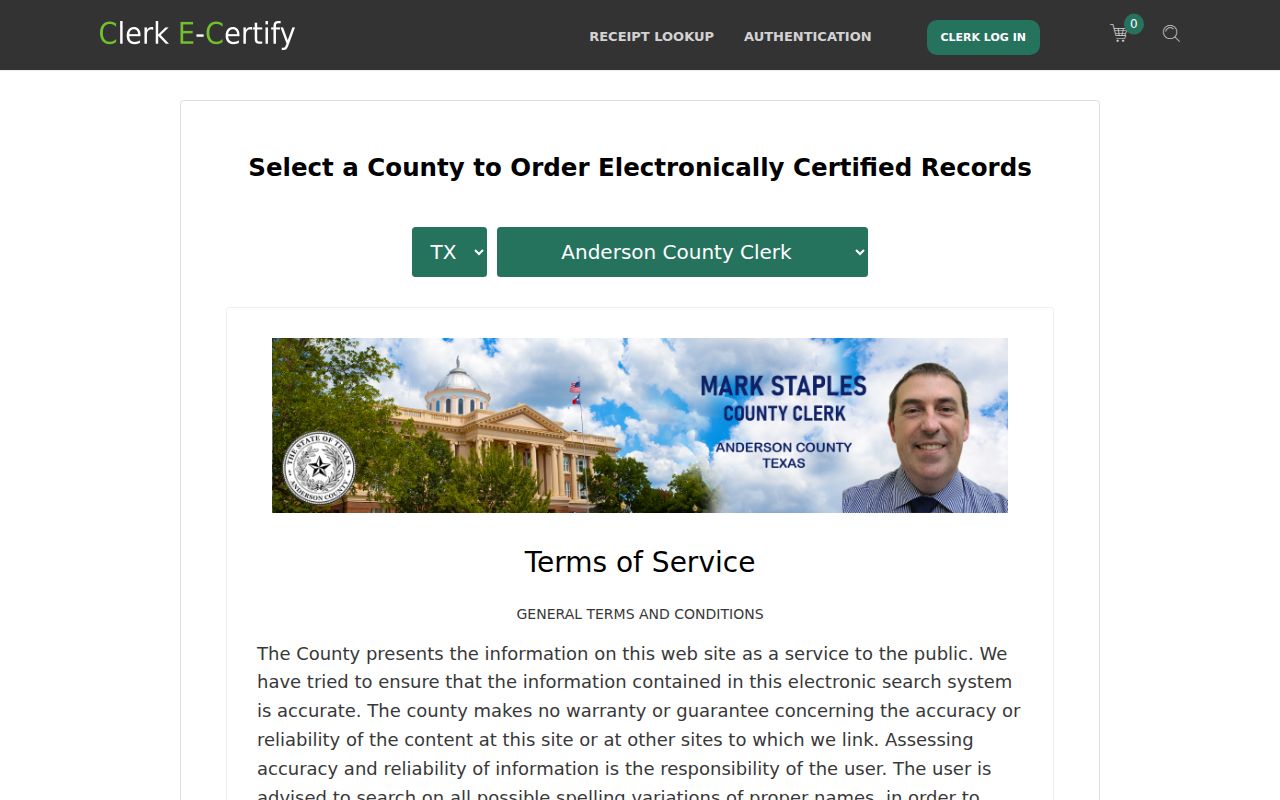
That first choice only routes the order. It does not prove the requested Anderson County court record is public or available electronically. A certified copy bears the clerk's own authentication, while an emailed plain scan stays uncertified no matter which clerk sent it.
Court Records: What They Contain
Read a usable Anderson County court record by field and by source. Names get shortened or entered several ways. The cause number and court assignment hold steadier. Event labels describe what the clerk's register recorded. A label seldom replaces the filed order itself. When you need to establish the court's action, request the document tied to that entry.
| Cause number | The stable court identifier used to search and request the file. |
|---|---|
| Court | The district, county, JP, or municipal court that owns the record. |
| Case style | The caption or abbreviated title, subject to privacy limits. |
| Filing event | The date and label for a pleading, motion, return, or notice. |
| Setting | A scheduled hearing or docket call, not the final outcome. |
| Order or judgment | The court's signed ruling or disposition document. |
| Access flag | A sealed, restricted, confidential, or redacted status. |
Keep the case number, court, date range, query terms, and the visible portal refresh notice. Anderson County Odyssey states that data are current through the prior business day. That refresh statement is not a promise that today's filing or correction has appeared yet.
Older Anderson County Case Files
A blank document tab on an Anderson County court case record does not always tell the truth. That does not mean the file is gone. Plenty of older papers were never imaged. A state integration may skip the item, or access to it may simply be restricted. There is no reliable county-wide retention cutoff. Nothing lets anyone guess which year made it online. Call the clerk responsible for the case instead. Have a few details ready: the court, the cause number, the rough filing date, the document type, and the date range you want.
The District Clerk's official page is the right first stop for current duties, office contacts, forms, and payment rules.

If a digital Anderson County court record will not display, the clerk's counter and phone line are the fallback. Ask what the office can actually do for you. Some items can be pulled up at a public terminal, copied from paper, or sent electronically, while others open only with court approval.
Copy Fees and Certification
For district records, the District Clerk fee schedule lists the exact charges. Those numbers do not control a County Clerk, JP, or municipal file. Each office sets its own rates. Confirm the current schedule and your total with the clerk before mailing any money. One separate warning comes from the County Clerk. Debit or credit transactions add a two-dollar processor minimum.
| District record item | Published fee | Request note |
|---|---|---|
| Paper copy | $1 per page | State page count or ask for an estimate. |
| Emailed electronic copy | $1 per document | Plain electronic copy unless certification is ordered. |
| Search without docket number | $5 | Give court, names, and date range to narrow the work. |
| Certificate or seal | $5 | Confirm the certification needed for the intended use. |
| Issuance, abstract, or bill of costs | $5 | Ask which document label applies. |
| Withholding order issuance | $15 | Listed separately on the district schedule. |
County Court at Law transcripts follow a different path. The court reporter needs a written request. It must name the case, the case number, and the hearing or trial date. You get an estimate first, then arrange payment, and only then does preparation begin. Keep in mind a transcript is its own product. It is not the clerk's docket or a minute entry.
Anderson County State Record Layer
re:SearchTX sits on top of county systems as a statewide layer for participating courts. Its official guide splits the work into Cases, Filings, Text, and Hearings. A case detail page can help confirm an Anderson County court record. Filing detail may point you toward a specific document. Text search depends on what got indexed. Hearing search zeroes in on event data. Accounts, local integration, confidentiality rules, and document availability all shape what you actually see.
Filter by the Anderson County court and cause number whenever you can. The statewide result never replaces the file the originating clerk maintains. Export and saved-search tools can help you track public information, but a vendor or state display can lag behind the clerk or normalize a name in a way that hides a match. The county-linked iDocket service also demands subscriber credentials. And it says its data should be confirmed with the clerk. One more caution: a case hit confirms an index result. It is not free access to every document behind it.
Access Rules for Court Records
Texas law treats case records, judicial records, and county administrative records as distinct things. Access to judicial records runs through the Texas Rule of Judicial Administration 12 framework. It routes a request to the proper custodian. And it offers an appeal path under Rule 12.9. The Texas Public Information Act covers government information broadly. Still, it is not a blanket demand for adjudicative court files.
Access boundary: Rule 76a governs sealing of covered civil court records. Family Code Chapter 58 limits juvenile access, and Government Code section 51.902 addresses safeguards for sensitive electronic court data.
A public index can show a cause number or a generic event. It may also hold back the document itself. Redaction may shield confidential content inside an otherwise public record. Never copy Social Security numbers or driver's license numbers. That ban also covers full birth dates, bank details, protected addresses, or sealed material. One more option exists for the right requester. The District Clerk keeps a dedicated sealed-record access form for anyone who can state the authority or role supporting access.
Precise Anderson County Requests
A narrow request is the kindest thing you can hand a clerk. It helps the office find the right Anderson County court case record fast. State the court, the cause number, the date range, and the document title. Say whether you need a plain or certified copy. Also say whether paper or electronic delivery works. If the record is not online, ask the clerk. Can the clerk pull it at the counter, accept a mailed request, or explain a restriction? Clerk staff can describe records, fees, and procedure. But they cannot recommend legal strategy.
Try something like: "I request the public docket for the named court and cause number, with entries for the stated date range, plus the signed order entered on the listed date." That phrasing separates a docket request from a document request. It also steers you away from a broad search built on a person's name alone. Whatever you find, verification should end with the Anderson County clerk or court that keeps the original. That office keeps the original file.