
Anderson County Criminal Docket Searches
The free online route is the county-linked Odyssey Public Access Case Records portal. Pick Criminal Case Records before typing anything. Jail and bond categories appear on the landing page too. But they cannot replace a court docket search. The portal states that data runs through the close of the prior business day. Same-day settings or brand-new orders may not show yet. So confirm those directly with the clerk.
A case number is the strongest search key. When it is unknown, narrow a name search by court, filing date, attorney, or citation number. Never assume a shared name is your person until the court and case number line up. The portal's own labels are the guide, since its form fields can change.
- Select the criminal records category and the correct Anderson County court.
- Enter the case number, or use the narrowest name and date details available.
- Match the court, filing date, offense label, and case status.
- Read settings, pleas, disposition entries, and document links in sequence.
- Confirm a court date or request a copy from the clerk that owns the file.
Anderson County Criminal Clerk Split
Court level decides which Anderson County clerk holds the criminal docket. Felony filings live with the Anderson County District Clerk for the 3rd, 87th, 349th, and 369th Judicial District Courts. The criminal desk lines are grouped by court: call 903-723-7463 for the 369th and 87th, and 903-723-7417 for the 349th and 3rd. The main desk number is 903-723-7443. Jot the court number on anything you pull from a search. County-level criminal work goes to the constitutional county court or the County Court at Law, with the County Clerk and District Clerk each supporting different pieces. Class C and citation cases stay with one of four Justice Courts or a city municipal court, so call the issuing court for those files. At the counter or by phone, have the case number, court, rough filing date, and the exact document or event you need. Ask whether a public terminal exists or whether the request must be mailed or placed on the clerk's copy form.
Criminal Dockets: What They Show
Think of an Anderson County criminal docket as an event index. It is not the full evidence file. Field labels differ from court to court. The entries described here draw on the county docket and an official Palestine municipal sample, so verify the felony display against a permitted live record.
| Case or cause number | The stable court identifier, shown in its assigned form; no unverified Anderson format should be assumed. |
|---|---|
| Court and filing date | The assigned district, county, JP, or municipal court and date the clerk opened the case. |
| Offense and agency | The filed charge or ordinance label and source agency; an offense entry is not a finding of guilt. |
| Status and setting | Events such as initial appearance, arraignment, pretrial, plea, trial, sentencing, reset, or warrant process. |
| Plea and disposition | The recorded plea and outcome code, read with the order, judgment, or dismissal entry. |
| Documents | Links or titles where electronic access is allowed; a blank tab may reflect an access limit. |
Anderson County Criminal Docket Terms
Local shorthand can quietly change what a quick scan means. The Palestine sample uses IA for initial appearance. A reset is just a new setting after an earlier date, never a dismissal. A warrant is compulsory court process. It can issue for more than one reason. The disposition line gives the outcome category, and the filed judgment controls the actual terms.
- Arraignment
- A formal accusation and plea-stage event.
- Capias pro fine
- Process tied to an unpaid judgment or missed show-cause setting in the municipal procedure described by Palestine.
- Deferred disposition
- A conditional procedure that may end in dismissal after compliance; it is not an ordinary conviction label.
- Nondisclosure
- A court-ordered limit on disclosure after a qualifying process, distinct from dismissal or expunction.
Some codes carry no definition on screen. Ask the clerk about any abbreviation that puzzles you. In Anderson County, DC can mean either the District Clerk or a district court depending on context, and CCL stands for County Court at Law.
Criminal Case Stages on the Docket
A felony docket in Anderson County opens once a filing reaches the District Clerk. From there the record may list arraignment, counsel activity, and bond events. Later lines can show motions, pretrial settings, a plea or trial, disposition, and sentencing. Cases skip steps, though. Settings repeat. And one charge in a cause can resolve differently than another.
Docket flow: Filing › Arraignment › Pretrial › Plea or Trial › Disposition › Sentencing
Read every line by date and document type. A setting proves only that something was scheduled. A motion entry does not mean the court granted relief. Check any dismissal code against the signed order to learn its scope. For a deadline or appearance date, treat the Anderson County criminal docket as a lead. Call the clerk or coordinator for that court.
Anderson County Municipal Criminal Process
Lower-court criminal dockets run on a separate track. Palestine Municipal Court handles city ordinance and Class C matters brought by Police, Fire Marshal, and Code Enforcement. A sample docket there lists the court date, judge, clerk, prosecutor, bailiff, status, citation number, docket number, offense, agency, and date and time. Private defendant names are left out here.
The official Palestine deferred-disposition page spells out one procedure that changes docket status. It covers the initial appearance, a guilty or no-contest plea, a waiver, costs and special expense, and a judge-set period of 1 to 180 days with conditions. Compliance can earn a dismissal. Eligibility is never automatic.
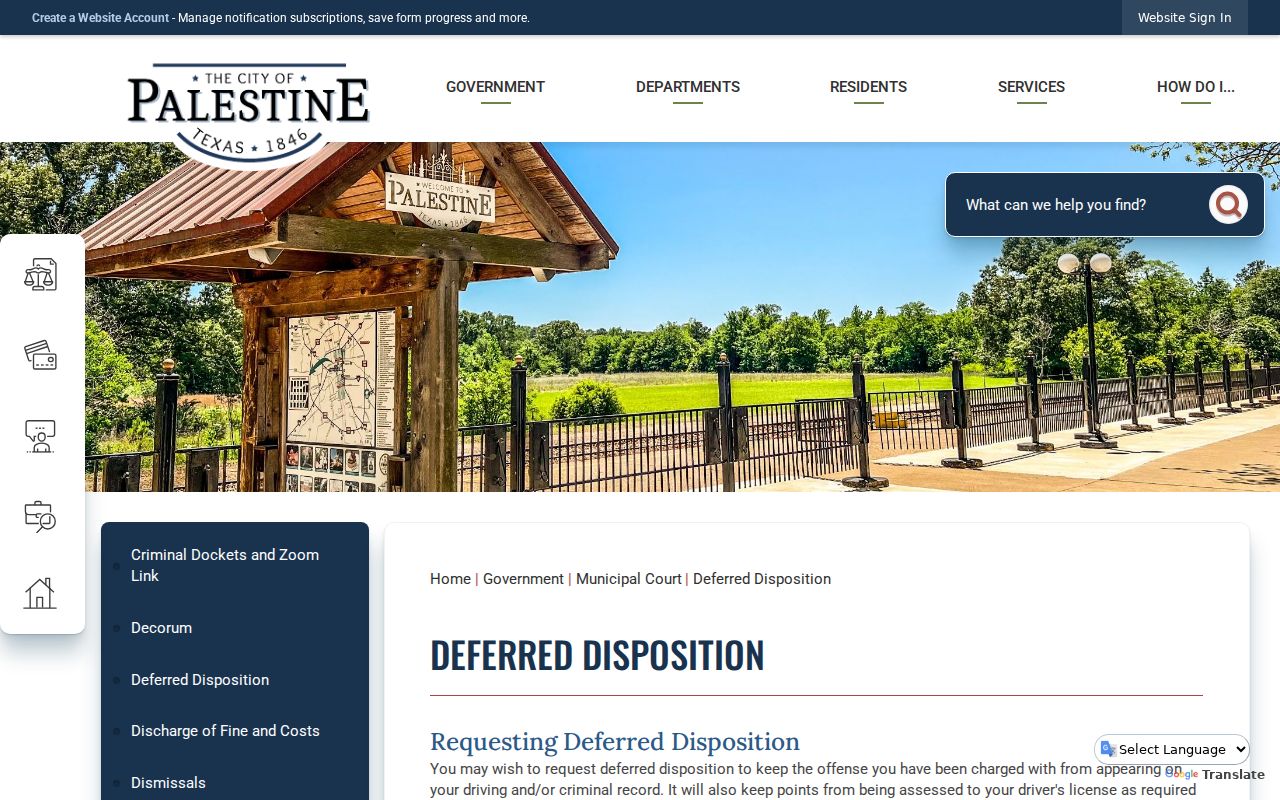
That official page shows why "deferred" is not a final outcome. The later docket entry and the court order tell whether the conditions were met.
Anderson County Criminal Docket Courts
Four Anderson County district courts hold the felony cases. The District Clerk keeps those criminal dockets. Fine-only and ordinance matters run on a separate track, with Justice Courts and the municipal courts in Palestine, Elkhart, and Frankston keeping their own dockets. JP4 flags citations issued by DPS, commercial motor vehicle enforcement, Parks and Wildlife, the Sheriff, and other agencies. Where a person sits in custody depends on the issuing court. A nearby courthouse address tells you nothing.
Federal charges never touch this county system. Anderson County sits in the Eastern District of Texas, Tyler Division, and those federal dockets live in PACER with the federal clerk. Appeals go to a different clerk too. The Twelfth Court of Appeals is the mapped intermediate court. Start from the trial court and its orders instead of guessing by county name.
Anderson County Criminal Docket Volume
The yearly totals give a sense of scale. They are not a roster of people or cases. For the district-court year running September 1, 2023, through August 31, 2024, Anderson County opened with 1,369 active criminal cases. It added 759 and disposed of 785. By the end it carried 1,290 active cases, with four reported as reactivated and four as inactive.
Those OCA figures measure workload and nothing more. They say nothing about convictions or how any single case turned out. A 2025 Justice Court report adds 2,406 criminal cases filed. It lists 1,377 still active at period end. Always pair each number with its reporting year and court level.
Anderson County Criminal Warrant Entries
A warrant flag calls for direct confirmation from the court. Palestine says a voluntary appearance may support recall of a failure-to-appear warrant. It cites its own municipal procedure. A capias pro fine is different. It is tied to an unpaid judgment or a missed show-cause event. These labels describe process, not a full case history. The city's official warrant information lays out its recall, payment, collection, and OMNI notices.
That local notice points to one lesson. A Palestine entry belongs with the municipal clerk, while a district felony docket or another city's case takes a different clerk route.
Access Rules for Criminal Dockets
Public access to an Anderson County criminal docket does not open every document. Texas law shields juvenile files, personal identifiers, sealed material, and records touched by expunction or nondisclosure. A public index may show a generic event while holding back the document behind it. For people who can state the right authority, the District Clerk posts a sealed-record access form.
If Odyssey comes up empty, registered users can try re:SearchTX. It gathers Cases, Filings, Text, and Hearings data. It draws that data from participating courts. Coverage varies. After that, call the responsible clerk. Visit the public counter or terminal. Or send a written copy request by mail or official form. Whatever a vendor or cached screen shows, the clerk-maintained record controls.
Key rules:
Texas Rule of Judicial Administration 12 supplies the judicial-record request and appeal framework.
Texas Government Code §§ 552.101 and 552.108 address confidential information and specified law-enforcement or prosecutor information.
Texas nondisclosure guidance explains how an order changes disclosure rules.