
How the Anderson County Court Calendar Works
Anderson County posts a County Clerk Docket Calendar for county-level settings. It shows a calendar view rather than a full register of filings. Day, week, month, and agenda views are available. Category tools such as General and Select All filter entries, and arrows move to the prior or next period. Those controls matter. A narrow date or category view can hide an event that shows up elsewhere.
Jurisdiction splits the Anderson County court schedule. The County Clerk handles County Court, County Court at Law, and probate work. The District Clerk keeps the dockets for the 3rd, 87th, 349th, and 369th Judicial District Courts. Four Justice of the Peace courts set their own dates. Palestine, Elkhart, and Frankston municipal courts control city cases. A calendar item marks a scheduled event only. It does not prove an order was signed or that a case closed.
Anderson County Court Schedule Controls
The County Clerk calendar does more than display dates. A print tool can produce a PDF or download of the current view. The iCal control copies an .ics calendar link. RSS copies an .rss feed link. Each output follows whatever view and category are selected at the time. A saved feed works well for tracking a public schedule. The court's later instruction still governs. The official controls sit on the Anderson County calendar source.
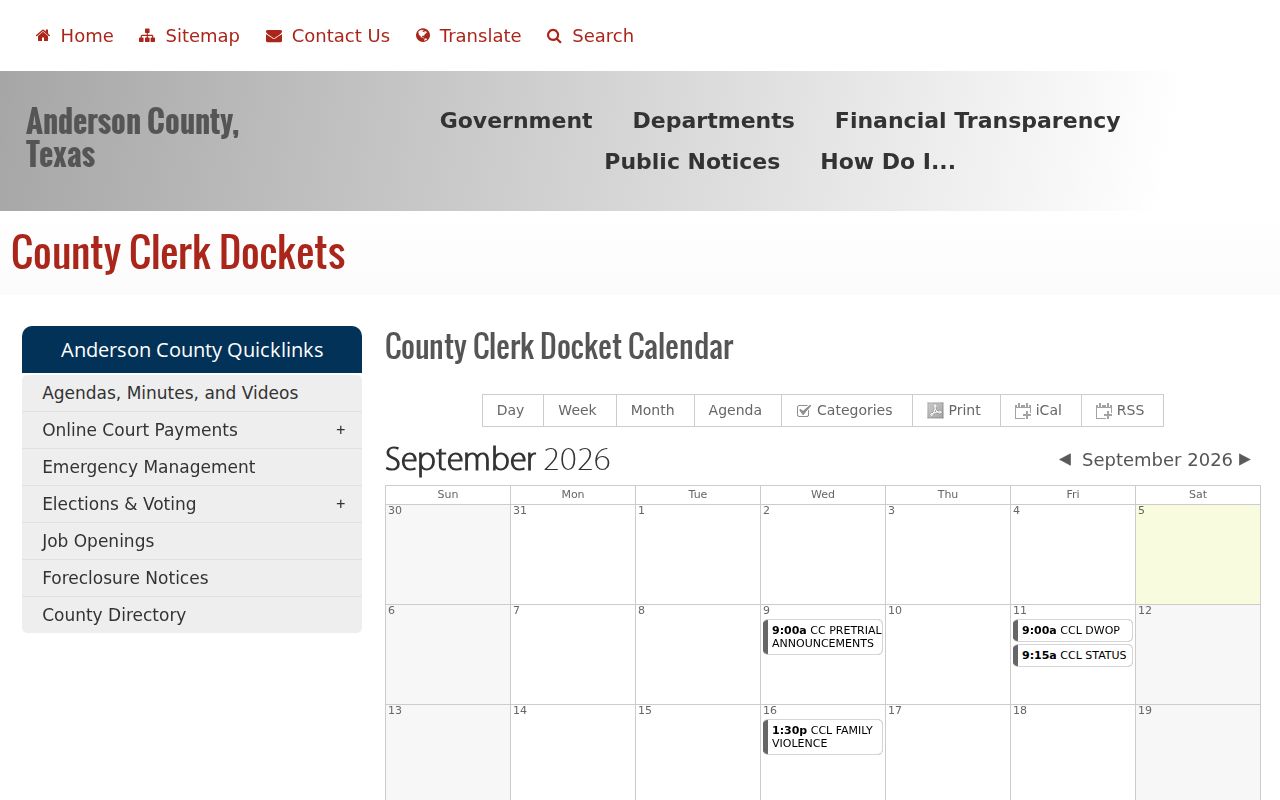
This is why the selected period and category matter. Treat a blank view with care. An empty day may simply mean the event sits in another period or category, or on a different Anderson County court schedule kept outside this calendar.
Anderson County Court Date Lookups
Use every route when a date matters. Online tools are easy, but settings move. A hearing can reset after a page was last refreshed. Anderson County's Odyssey landing page states its data is current through the end of the previous business day. That statement is only a refresh note. It is not a promise that a same-day reset or signed order has already appeared.
- Open the County Clerk calendar for a county-level setting, or choose Court Calendar on the official Odyssey portal.
- Use the case number and correct court whenever the current interface permits it. Record the setting type, date, and time.
- For a district case, call or visit the Anderson County District Clerk. For County Court at Law or probate, contact the County Clerk or court office.
- For a JP or municipal matter, use the phone, counter, mail, fax, email, or posting channel published by that court.
- Ask counsel when represented, check any courtroom or courthouse posting, and confirm the setting close to the appearance date.
The County Clerk sits at 500 N. Church Street, Room 10, Palestine, reachable at 903-723-7402. The District Clerk is in Room 18 of the same courthouse at 903-723-7412. A written or mailed request should state the court, case number, date range wanted, and the exact calendar information sought.
Anderson County Courts Keep Separate Schedules
Which Anderson County court schedule applies? A case's level gives the answer. Felony, district civil, family, and juvenile proceedings run through the District Clerk. County Court at Law, probate, and qualifying county civil matters generally involve the County Clerk. Citation, eviction, and small-claim settings stay with the issuing Justice Court precinct. A city ordinance or Class C case belongs to the municipal court. The citation names that court.
District setting A district court calendar event. Anderson County has four of them.
County setting A date on a County Court, County Court at Law, or probate docket.
Justice setting A hearing before JP Precinct 1, 2, 3, or 4.
Municipal setting A city court date handled by Palestine, Elkhart, or Frankston.
One courthouse area can host several offices. That trip to Palestine does not mean every Anderson County filing lives in the same place. A JP citation belongs with the Justice Court, not the District Clerk. Check the paperwork before you go.
The citation, notice, or earlier docket entry usually names the court handling the case. When it stays silent, the Texas judicial directory lists each county court with its contact routes.
Court Settings: What Each Field Means
Read a setting line as a set of linked facts, not a single date. The date alone tells you little. Match the court and the setting type. Match the cause or docket number too, before you plan around it. Anderson County's calendar posts no case-level sample. So the table here walks through setting fields common to the county calendar and the official Palestine municipal docket without guessing at a local field order. Treat it as a general map of a court docket entry.
| Date | The scheduled day, subject to a later reset or cancellation. |
|---|---|
| Time | The appearance time or docket-call time. Confirm whether an individual time applies. |
| Courtroom | The room or location assigned by the court. Verify it with the responsible office. |
| Judge | The listed presiding judge or case-judge assignment, which may change. |
| Setting Type | The purpose, such as initial appearance, arraignment, pretrial hearing, motion hearing, or trial. |
The Palestine sample goes further, listing court date, judge, clerk, prosecutor, bailiff, status, citation number, docket number, offense, agency, and time. Those are municipal fields. They do not prove the County Clerk or District Clerk shows the same screen for a case lookup.
Blank Anderson County Court Calendar Views
An empty screen proves very little. A hearing can exist even when nothing renders. Switch the view from Day to Week or Agenda. Then check the periods just before and after the one you opened. The category control matters too. General and Select All may return different results. And if the case sits in a district, JP, or municipal court, it may never appear in the County Clerk calendar at all.
The Odyssey Public Access portal offers another route. It has a Court Calendar category beside criminal, civil-family-probate, judgments, and jail options. Visitors sometimes hit a redirect loop before the live search fields load. Follow the labels actually on the screen rather than a form you assume. If Odyssey will not cooperate, go to the clerk counter or call directly. Ask whether a public terminal exists before you travel. Anderson County does not publish how many terminals it keeps or where they sit.
Keep the request tight. Name the court and the case number. Add a party or citation identifier, and the date range you want. Ask for the next setting and whether it has been reset. That anchors your inquiry to one known case.
When a Court Date Moves
Each term means something different. A reset simply assigns another date. A continuance postpones a proceeding by court action, and a cancellation removes the listed event. None of these means the case was dismissed. The change may surface as a new calendar item, a docket entry, or a later order. Timing varies by court and by how fast the local system updates.
Hold on to the original notice. Write down the case number and note when you checked the online calendar. Then confirm the Anderson County court schedule with the responsible clerk or your attorney. Odyssey posts changes only a prior business day out, so call after any recent hearing. For a County Court at Law setting, the office sits at 500 N. Church Street on the third floor, at 903-723-7469. A court reporter's transcript is a separate product. It takes a written case-and-date request and a prepayment arrangement, and exporting the calendar gets you nothing of the sort.
Texas electronic-hearing guidance never overrides a local appearance order. Rely on the latest notice issued in the case. If two sources conflict, sort out the court's direct instruction with the court office before the setting.
Palestine Dates on Anderson County Schedules
Palestine Municipal Court offers an official criminal-docket route. It is a clear model for reading city settings. Its sample lists the court date, citation number, docket number, offense, agency, status, and time. Header fields identify the judge, clerk, prosecutor, and bailiff. That format belongs to the municipal court alone. Do not copy private names from a live docket.
The court sits at 504 N. Queen Street. Court-date questions go to 903-731-8433, while the main number is 903-731-8400. The city states that, effective August 1, 2026, Zoom is no longer a default appearance option. Scheduled defendants and guardians must appear in person unless the court directs otherwise. That change shows why an old link can never replace current instructions.
Elkhart lists municipal-court availability on the first Thursday of each month from 4 to 5 p.m. through City Hall. Frankston provides a City Hall and ordinance route but posts no separate public calendar. For either city, call City Hall and ask for the municipal-court clerk or records custodian.
Missed Settings and What Comes Next
Act quickly after a missed Anderson County court setting. Contact the court named on the notice, not a different clerk on the courthouse campus. Give the case or citation number, then ask for current status, any new date, and the proper procedure for addressing the missed appearance. If counsel represents a party, contact counsel at once.
Missed a setting? A missed date may lead to a failure-to-appear action, warrant, bond consequence, or other court order.
Call the responsible clerk or court now and confirm what the official docket shows.
Legal advice about a warrant, bond, or response must come from a licensed attorney, not clerk staff.
A clerk can explain record access and procedural routes but cannot recommend legal strategy. Never assume that payment clears a prior order. A phone call will not do it either, nor will a new online date. Ask what written confirmation the court provides. The Anderson County docket search can help you locate the case before calling the clerk.
Anderson County Calendar Versus Final Record
The Anderson County court schedule tells you when an event is set. The docket shows what procedural entries have been recorded. A filed order or certified disposition supplies stronger proof of what the court decided. Different offices may hold these products. A calendar export is no substitute for the signed document.
| Record | Best use | Confirm with |
|---|---|---|
| Calendar setting | Find a planned date, time, and setting type | The court or its clerk |
| Docket entry | Trace filings, settings, resets, and recorded action | District, county, JP, or municipal clerk |
| Signed order | Read the court’s actual ruling | The custodian of the case file |
| Reporter transcript | Obtain the spoken proceeding when available | The court reporter through a written request |
For an official copy, name the exact document. Then ask the correct custodian about access and fees. Texas Rule of Judicial Administration 12 governs access to judicial records. The Texas Public Information Act usually covers non-case administrative records. Restricted, sealed, juvenile, or nondisclosed material requires the proper route.