
Anderson County Court Docket Searches
Start at Odyssey Public Access Case Records, the county's official online route. The landing page splits searches into Criminal Case Records; Civil, Family & Probate Case Records; Judgments Search; Court Calendar; Jail Records; and Jail Bond Records. Choose a category first. Then enter your term. A case number works best, since names repeat and clerks often abbreviate them.
The Anderson County court docket portal refreshes its data only through the end of the previous business day. Read that as a lag, not a promise. An order signed this morning may not appear yet. The live screen can change. Rely on the fields and controls actually in front of you rather than any assumed list.
- Identify the court level from the papers, citation, or prior docket entry.
- Open the official Anderson County portal and choose the matching case category.
- Search by case number, or narrow a name with court, date, case type, or agency data.
- Compare the filing date, court, status, parties, and event history.
- Confirm an urgent setting or request a copy from the clerk that keeps the file.
Anderson County Odyssey Docket Portal
Odyssey's categories answer different questions, and mixing them causes errors. A jail record is not a criminal court result. A calendar event is not a signed order. A judgments search may show an outcome while skipping the filings that led there. Whatever you pull, note the Anderson County court docket category and the court assignment together. The official Odyssey landing page lists the county's categories and carries the prior-business-day notice.
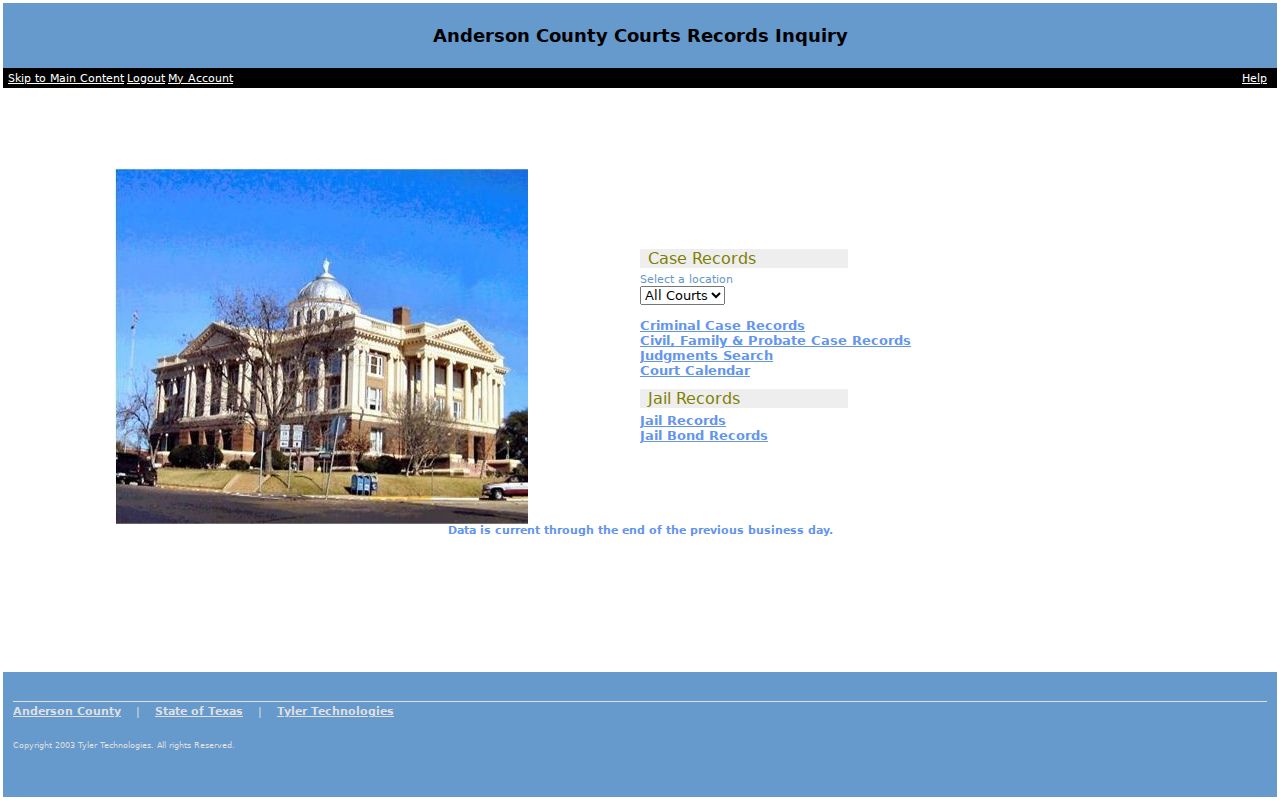
This is why the first move in any Anderson County docket search is picking the right record category. It also explains why the clerk is worth a call when a fresh event has not posted yet.
| Search anchor | Best use | Check before relying |
|---|---|---|
| Case or cause number | Direct Anderson County case match | Court and filing date |
| Party or defendant name | Locator when the number is unknown | Spelling, role, court, and date |
| Citation or cross-reference | Municipal, JP, or agency-linked matter where shown | Issuing court and agency |
| Attorney and date | Narrowing a broader result set | Case type and current status |
Court Dockets: What They Show
Think of an Anderson County court docket as a dated index of what has happened in a case. It names the court, the case number, filing date, parties, attorneys, documents, settings, and outcome codes. Still, it is not the whole file. A document's title can show up even when its image is restricted, missing, or available only by request.
| Case number | The stable court identifier; retain the court number with it. |
|---|---|
| Case style and parties | The caption and roles such as plaintiff, defendant, petitioner, or respondent. |
| Filings and service | Pleadings, motions, orders, citations, notices, and returns listed by date. |
| Settings | Hearing, docket call, arraignment, trial, or other scheduled event. |
| Status and disposition | Current stage or outcome category, read with the actual order or judgment. |
| Access flag | An indication that a filing is sealed, confidential, restricted, or not online. |
Local shorthand trips people up. In the Palestine municipal sample, IA means initial appearance. A reset sets a new date; it does not dismiss anything. CCL is the County Court at Law. DC can mean District Clerk or district court, depending on the source.
Anderson County Docket Access Layers
Three tools, three questions. The Anderson County calendar finds a setting. Odyssey or re:SearchTX finds a case and its event register. A clerk request gets you a plain or certified document. Moving across those layers keeps a calendar entry from being read as a final ruling.
| Layer | What it answers | Official route |
|---|---|---|
| Calendar | When a listed setting may occur | County Clerk Docket Calendar or the responsible court |
| Case docket | What events and filings appear in sequence | Odyssey and participating re:SearchTX data |
| Document | What a filed order, pleading, or judgment actually says | District Clerk, County Clerk, JP, or municipal clerk |
When the online layer falls short, the old routes still work. Use the public terminal, the clerk counter, a phone call, a mailed request, or the official copy form. Ask exactly how a document is available: electronically, on paper, by inspection, or only after an access review.
Anderson County Courts and Their Dockets
Anderson County runs four district courts, a constitutional county court, a County Court at Law, four Justice Courts, and three incorporated-city municipal contexts. Records follow the court, not the building. The District Clerk keeps district felony, civil, family, and juvenile filings. The County Clerk handles county, County Court at Law, and probate work as assigned. Every JP and municipal court keeps its own docket.
| Court | Docket covers | Where to search |
|---|---|---|
| 3rd, 87th, 349th, and 369th District Courts | Felony and district civil or family matters | Odyssey, re:SearchTX, then Anderson County District Clerk |
| County Court and County Court at Law | County-level civil, criminal, family, and probate work as assigned | Odyssey, calendar, County Clerk or District Clerk |
| JP1 through JP4 | Class C, small or debt claims, eviction, and other JP matters | The precinct court named on the case or citation |
| Palestine, Elkhart, and Frankston Municipal Courts | City ordinances and municipal Class C matters | The specific city court or City Hall route |
| Eastern District of Texas, Tyler Division | Federal cases | PACER and the federal clerk, not county Odyssey |
Anderson County Docket Clerk Split
The Anderson County District Clerk maintains the district courts' acts and proceedings, enters judgments, records executions and returns, and keeps the party index. That office holds all felony filings, district civil and family matters, and juvenile proceedings. Find it on the first floor of the courthouse at 500 N. Church Street, Room 18, Palestine, Texas 75801. The public phone is 903-723-7412.
County Clerk Mark Staples handles County Court and County Court at Law work, probate and county civil records, criminal and jury functions, and other county records. That office sits at 500 N. Church Street, Room 10, Palestine, Texas 75801, phone 903-723-7402. Counter hours run Monday through Friday, 8 a.m. to noon and 1 p.m. to 5 p.m.
For any request, give the court, the case number, the record type, and the date range. Say whether you want inspection, a plain copy, or a certified copy. The clerk can explain procedure and fees but cannot advise you on legal strategy.
Court Dates and Settings in Anderson County
The County Clerk Docket Calendar offers Day, Week, Month, and Agenda views. Category controls and prior/next navigation sit alongside them. PDF printing, iCal, and RSS links round it out. It is a strong tool for finding settings. An empty view, though, may just reflect the day or category you picked. It proves nothing about whether an Anderson County case is closed. The official calendar page displays the available view and export controls.
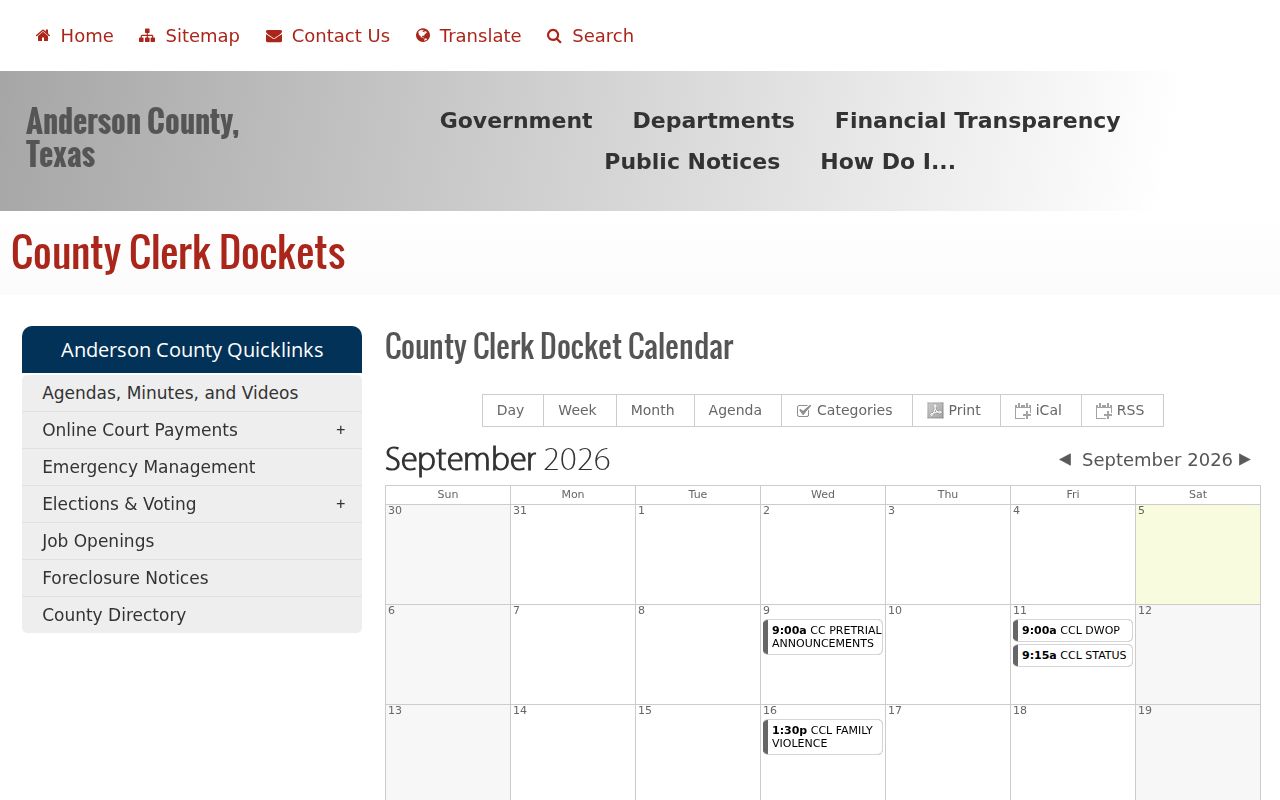
Anderson County settings can be viewed, printed, or subscribed to from this page. A date may change or feel urgent. The clerk or court coordinator is still the best source.
A setting is not a disposition. Criminal settings cover arraignment, pretrial, plea, trial, or sentencing. Civil settings cover docket call, temporary orders, prove-up, trial, discovery, or status conference. When a setting moves, the docket may show a reset or continuance. Confirm the new date with the court named in the case.
Anderson County and State Dockets
re:SearchTX adds a statewide layer beyond local access. You must register or sign in before searching. The portal searches Cases, Filings, Text, and Hearings. Filters and saved or exported results come where your account and the integrated data allow them.
For Anderson County dockets, start with Odyssey. Turn to re:SearchTX when a state-integrated filing or hearing might fill a gap. Neither portal carries every document. Local participation, confidentiality, sealing, and account limits shape what shows up. Remember that the clerk-maintained record controls over any cached or vendor display. Attorneys and parties file through eFileTexas. It is not a general public docket search.
Federal cases touching Anderson County run on separate rails. The Eastern District of Texas, Tyler Division relies on PACER and CM/ECF. An appeal moves to a different clerk entirely. The Twelfth Court of Appeals is the mapped intermediate appellate court.
Docket Access Under Texas Law
For Anderson County categories, start with Odyssey. Turn to re:SearchTX when a state-integrated filing or hearing might help. Neither portal promises every document. Local participation, confidentiality, sealing, and account access all shape what appears. Remember that the clerk-maintained record controls over any cached or vendor display. Attorneys and parties file through eFileTexas. It is not a general public docket search.
Key rules:
Texas Rule of Judicial Administration 12 supplies the judicial-record request and appeal framework.
Texas Government Code §§ 552.021 and 552.101 address public availability and information made confidential by law.
Texas Rule of Civil Procedure 76a governs sealing in covered civil proceedings.
Texas Government Code § 51.902 addresses preservation and redaction safeguards for electronic court records.
When that framework applies, ask for a judicial record with a written Rule 12 request. A non-case administrative record may instead fall under the Texas Public Information Act. The responsible custodian can point you to the correct route and may redact protected data rather than release it.
Anderson County Docket Workload
Official OCA activity figures show the scale of Anderson County court operations. In the district reporting year ending August 31, 2024, the four district courts reported 1,477 cases added and 1,437 disposed, with 2,728 still active at period end across civil, family, juvenile, and criminal categories. Treat these as administrative totals, not search results.
The Justice Courts reported 3,264 cases added. They also reported 3,035 disposed and 2,464 ending active for the year ending August 31, 2025. Don't merge different reporting years into one trend. Added, disposed, inactive, reactivated, and ending active are workload terms. They say nothing about any person's conduct or case result.
How the Clerk Keeps Docket Records
Every docket starts with the clerk. In Anderson County, the clerks record court action, keep the indexes, and control access under the court's authority. The District Clerk holds the district files. County and probate matters sit with the County Clerk. Justice and municipal cases stay with the precinct or city court that issued them. Name the right court in any request. The official County Clerk page posts the office hours, payment notice, and record links.
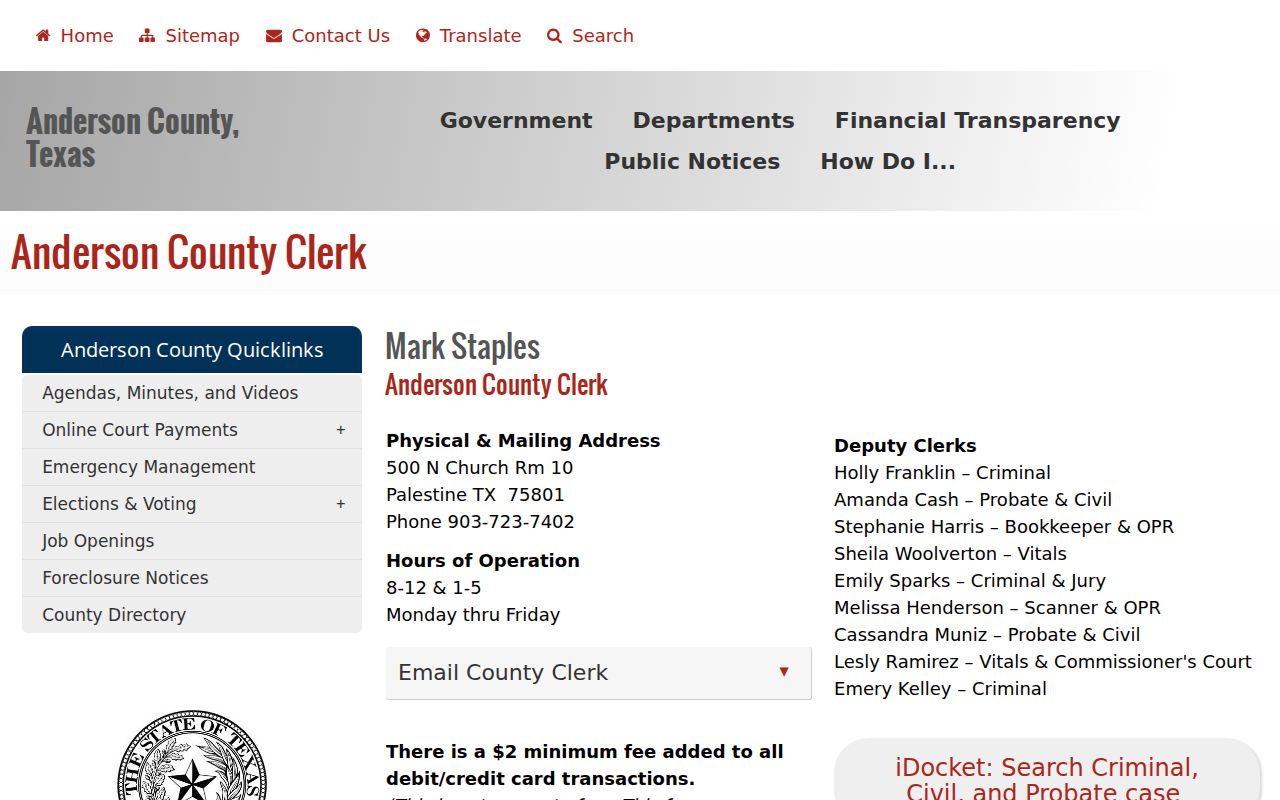
The page spotlights the Anderson County office that handles county records. That keeps the County Clerk's duties distinct from the District Clerk, who keeps the district court docket.
Anderson County District Clerk
500 N. Church Street, Room 18
Palestine, TX 75801
903-723-7412
District felony, civil, family, and juvenile docket records.
Anderson County Clerk
500 N. Church Street, Room 10
Palestine, TX 75801
903-723-7402
County, County Court at Law, probate, and assigned county docket records.
Anderson County Docket Copy Costs
The Anderson County District Clerk fee schedule splits docket work into parts. A search costs $5 when you do not supply the case number. Paper pages run $1 each. Electronic documents emailed to you also cost $1. A certificate or seal adds $5. The same $5 fee applies to an abstract. It also applies to a bill of costs, bond approval, and certain issuance and process items. Confirm the current schedule before you order copies from the clerk's office.
| District Clerk item | Published amount | Useful request detail |
|---|---|---|
| Search without docket number | $5 | Court, name, and date range |
| Paper copy | $1 per page | Document title and page range |
| Electronic copy | $1 per document | Email and document title |
| Certificate or seal | $5 | State that certification is required |
Watch the payment rules. The County Clerk adds a $2 minimum processor charge on debit or credit card payments. The District Clerk works differently. Since January 1, 2020, its office takes no checks at all. Ask each clerk about fees for e-certify or other work.
Anderson County Docket Geography
Palestine holds most of the county's public court work. The county courthouse sits at 500 N. Church Street, and the County Judge plus some Justice offices work from 703 N. Mallard Street. Palestine Municipal Court keeps its own docket at 504 N. Queen Street. So one city can hold several separate court calendars side by side. Across its 1,062.3 square miles, Anderson County reports a home population of 57,922. The official Anderson County home page lists county contacts and links into case records and Research Texas.

The current courthouse went up in 1913 and 1914. Fire destroyed its predecessor earlier in 1913. Before that, county court work started in a log house at Fort Houston back in 1846. That old history now runs beside Odyssey, re:SearchTX, eFileTexas, calendar exports, clerk counters, and mailed copy requests. A docket search today starts from the county's official web entry point. Skip the unverified record aggregator.
City-by-City Court Dockets in Anderson County
Anderson County counts just three incorporated cities: Palestine, Elkhart, and Frankston. Each municipal court keeps its own docket for city ordinance and Class C matters. A city name alone won't tell you which court has the case, since a Justice Court or county matter can arise in the same area. Read the issuing court straight off the citation or case paper.
Palestine Court Records
2020 Census population 18,544. Palestine publishes a municipal docket route and court contact information for city citations.
Elkhart Court Records
2020 Census profile population 1,287. Elkhart uses its City Hall and monthly municipal-court availability route.
Frankston Court Records
2020 Census profile value 1,097. Frankston uses City Hall and its ordinance route because no public city docket portal was located.
A municipal citation stays with that city court unless a lawful transfer or appeal moves it. County-level matters belong to the Anderson County clerks or the JP precinct. Federal matters go to the Tyler Division.
Map and Directions to the Anderson County Courthouse
The Anderson County District Clerk keeps the felony, district civil, family, and juvenile filings for the county's four district courts — the 3rd, 87th, 349th, and 369th Judicial District Courts — on the first floor of the Anderson County Courthouse, Room 18, 500 N. Church Street in Palestine. The County Clerk's probate and county-level records sit in Room 10 of the same building, and the County Court at Law sits on the third floor.
Anderson County District Clerk
500 N. Church Street, Room 18
Palestine, TX 75801
903-723-7412
Anderson County Clerk
500 N. Church Street, Room 10
Palestine, TX 75801
903-723-7402
Monday through Friday, 8 to noon and 1 to 5
New District Clerk filings are due by 4:30 p.m. on business days, and the office has not accepted checks since January 1, 2020. The county's inspected sources do not document courthouse parking, security screening, or ADA request procedures, so calling ahead is the safer plan before a visit.